

Is Soil Testing Worth It for Your Lawn?
- LawnLogIQ

- 2 days ago
- 6 min read
A lawn that looks tired after repeated fertilizer treatments is not asking for more product. It is asking for better information. That is why the real question behind is soil testing worth it is not about cost alone. It is about whether you want to manage turf by assumption or by evidence.
For homeowners who care about consistent color, density, and long-term turf performance, soil testing is often one of the highest-value decisions they can make. Not because every lawn needs a lab report every month, but because healthy turf is built from the root zone up. If the chemistry, nutrient balance, or pH in the soil is off, even well-timed applications can underperform.
Is soil testing worth it for a residential lawn?
In many cases, yes. Especially if you have an established lawn, recurring issues, or a history of generic treatments that have produced average results at best.
A proper soil test can identify whether the lawn is actually deficient in key nutrients, whether phosphorus levels are already excessive, whether potassium is limiting stress tolerance, and whether soil pH is reducing nutrient availability. Those are not minor details. They directly affect how turf responds to fertilization, weed pressure, summer stress, and disease vulnerability.
The bigger point is this: without testing, most lawn care is based on probability. With testing, it becomes a measured agronomic decision.
That does not mean every homeowner needs a complex scientific program. But if you are investing real money into your property and expect more than commodity-level results, testing usually pays for itself by improving decision quality.
What a soil test actually tells you
Many homeowners hear “soil test” and think it simply tells them whether the lawn needs fertilizer. That is far too narrow.
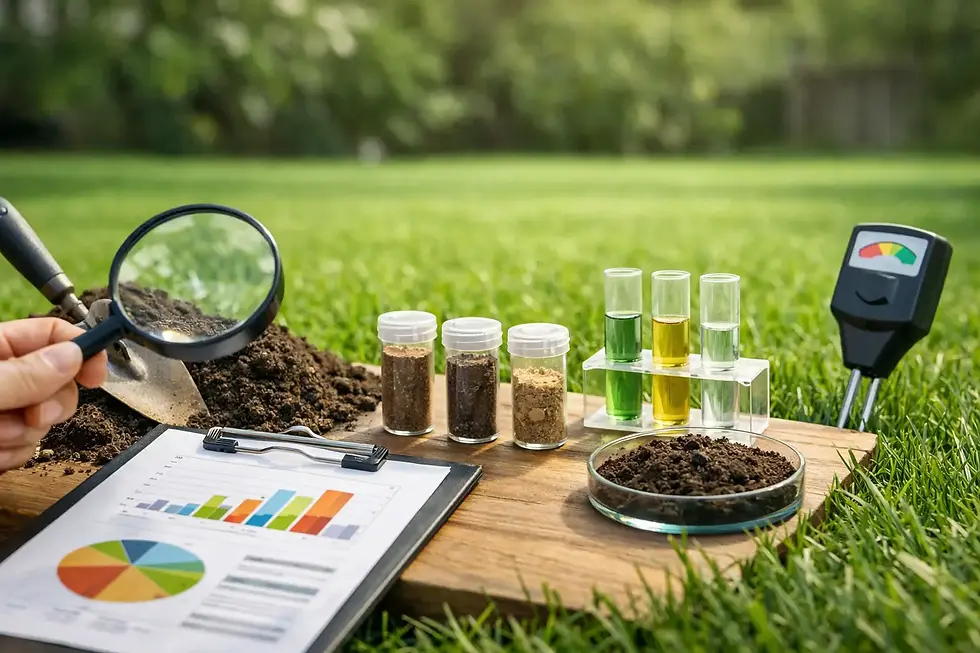
A lab-certified soil analysis typically evaluates pH, buffer pH, organic matter, cation exchange capacity, and the current levels of major and secondary nutrients such as phosphorus, potassium, calcium, and magnesium. Depending on the protocol, it may also assess micronutrients and soluble salts.
That matters because turf response is rarely about one number in isolation. A lawn may have plenty of nutrients in the soil and still perform poorly if the pH is restricting uptake. It may show weak summer performance not because it lacks nitrogen, but because potassium reserves are low and root function is compromised. It may be getting phosphorus year after year even though phosphorus is already abundant.
This is where testing separates professional management from routine treatment. We do not guess; we test. And once you test, the lawn stops being a mystery.
Soil tests help answer the right question
The wrong question is, “What product should I put down next?”
The right question is, “What is the soil condition limiting turf performance right now?”
Those are very different approaches. The first leads to generic schedules. The second leads to a custom nutrient strategy built around what the site actually needs.
When soil testing is most worth it
Testing has the strongest return when the lawn is underperforming or when the homeowner wants a more exact standard of care.
If your turf has inconsistent color, chronic thinning, weak summer recovery, recurring weed breakthrough, or poor response to fertilizer, testing is worth serious consideration. The same is true if you have recently moved into a home and do not know the treatment history. Established suburban lawns often carry years of accumulated applications, and that history matters. It is not unusual to find nutrient imbalances caused by repeated blanket programs.
In the Chicago suburban market, this is especially relevant because soils can vary substantially from one property to the next. Construction disturbance, imported topsoil, compaction patterns, and drainage conditions all affect how a lawn behaves. Two homes on the same street may need very different agronomic plans.
Testing is also worth it before making major correction decisions. If a homeowner is considering lime, specialty fertilizers, or a more intensive improvement plan, the smartest starting point is data.
When soil testing may not be necessary
There are cases where a soil test is less urgent.
If the lawn is already performing well, the treatment history is known, and the goal is basic upkeep rather than premium performance, annual testing may be more than is needed. A healthy lawn with stable results does not always require frequent analysis.
There is also a difference between testing because a problem exists and testing simply to collect numbers. Good management is not about paperwork for its own sake. It is about using diagnostics when they improve outcomes.
That said, many homeowners assume their lawn is “fine” because it is green for part of the season. A lawn can look acceptable in May and still carry imbalances that show up under July heat, weed competition, or disease pressure. So while constant testing is unnecessary, informed baseline testing is often wise.
The cost question homeowners actually care about
Most people asking is soil testing worth it are really asking whether the value justifies the added expense.
Fair question. The answer depends on what the test helps you avoid and what it helps you improve.
If a soil test prevents unnecessary phosphorus applications, identifies a pH issue before years of weak performance continue, or redirects fertilizer strategy toward what the lawn can actually use, it can save money over time. More importantly, it can save a full growing season of frustration.
For premium homeowners, the calculus is even clearer. If you are already spending on lawn treatments, irrigation support, seed improvements, or renovation work, then operating without a verified soil profile is like making investment decisions without reviewing the numbers first. The larger the standard you expect, the less sense guesswork makes.
Why generic lawn programs often skip this step
Traditional lawn care models are built for efficiency across volume accounts. That model favors repeatable schedules, standardized products, and broad assumptions. It does not favor individualized diagnosis.
Soil testing introduces precision, but it also introduces complexity. Once the lab results come back, the provider has to interpret them, adjust the nutrient plan, and often explain why one lawn is receiving a different approach than another. That requires agronomic oversight and operational discipline.
Many companies are not structured that way. Their model is maintenance over management.
For homeowners who want stronger accountability, that distinction matters. A lawn should not receive products simply because the calendar says it is time. It should receive applications because the site conditions support that decision.
What soil testing does not do
A soil test is powerful, but it is not magic.
It does not directly diagnose fungal disease, insect pressure, irrigation failure, shade stress, or compaction severity. It will not tell you everything happening biologically in the turf canopy. And it does not replace inspection frequency.
That is an important trade-off. Some homeowners expect one test to explain every problem on the property. In reality, soil chemistry is one part of turf performance. A complete management program also considers mowing practices, moisture patterns, weed pressure, seasonal timing, and root zone behavior.
Soil testing should be viewed as a foundational diagnostic tool, not a standalone cure.
How to know if your provider is using soil testing correctly
Not all testing is equal. A meaningful program should go beyond pulling a sample and handing over a printout.
A credible provider should explain what was tested, what the numbers mean, what conditions are limiting performance, and how the treatment plan changes as a result. If the recommendations remain identical regardless of the results, the testing is not being used properly.
This is where a science-driven firm stands apart. The value is not just in generating data. The value is in translating that data into a practical nutrient prescription, then adjusting through the season based on inspection and response.
That is management over maintenance.
So, is soil testing worth it?
If your goal is a basic green lawn at the lowest possible cost, maybe not every time.
If your goal is to understand what the lawn actually needs, avoid wasted applications, correct hidden limitations, and build a stronger turf system over time, then yes - soil testing is worth it.
The homeowners who benefit most are usually the ones who are done tolerating average results. They are not looking for more treatments. They are looking for better decisions.
And that is exactly where soil testing earns its value. It replaces assumption with evidence, and evidence is what turns a lawn program from routine service into real agronomic control.
A better lawn rarely starts with adding more. It usually starts with measuring what is already there.


Comments