
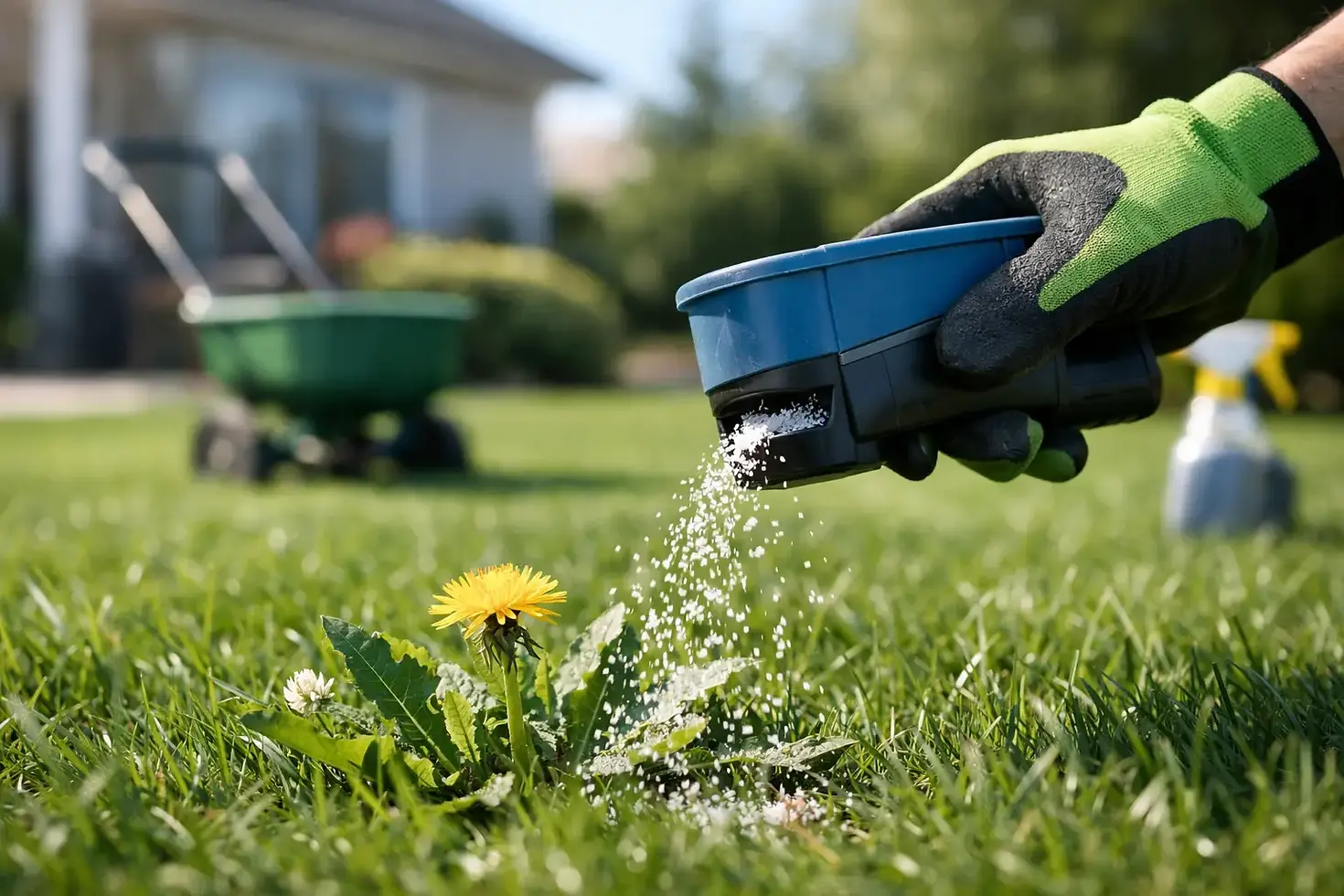
Weed Control for Established Lawns That Lasts

A lawn can look dense from the street and still be losing ground below the canopy. A few dandelions or clover patches are rarely the real problem. Effective weed control for established lawns begins by identifying why weeds have room to establish in the first place: thin turf, compacted soil, poor nutrient balance, uneven moisture, insect activity, or a treatment applied outside its proper window.
That distinction separates lawn management from a commodity spray schedule. Herbicides have a role, but they are not a complete strategy. A high-performing established lawn suppresses weeds through density, root health, and correct agronomic inputs. We do not guess; we test, inspect, and treat the actual condition of the turf.
Why Weeds Take Hold in Established Turf
Weeds are opportunists. They occupy openings in the turf canopy, exploit stressed root systems, and respond quickly when desirable grass is not competitive. That is why two neighboring lawns can receive the same weed treatment and produce very different results.
In the Chicago suburbs, common broadleaf weeds such as dandelion, plantain, clover, ground ivy, and creeping Charlie often point to different underlying conditions. Clover may indicate low available nitrogen or thin turf. Plantain commonly appears in compacted, high-traffic areas. Ground ivy favors shade and persistently moist soil. Crabgrass and other annual grassy weeds typically reveal gaps in coverage or a missed pre-emergent timing window.
The visible weed matters, but the site conditions matter more. Treating clover without addressing the turf’s nutrient demand can produce a temporary visual improvement, followed by another invasion. Applying broad-spectrum products to ground ivy in a shaded, poorly drained section may reduce it briefly without changing the environment that favors it.
A precise program begins with diagnosis. Identify the weed, evaluate its growth stage, review turf density, and assess soil chemistry and biological health. Then decide whether the right move is selective post-emergent treatment, preventive control, nutrient correction, cultural adjustment, or a combination of those measures.
Weed Control for Established Lawns Is a Timing Problem
The calendar matters, but weather and plant development matter more. A generic service schedule treats every property as if weeds emerge, mature, and respond on the same date. They do not.
Pre-Emergent Control Protects Open Ground
Pre-emergent herbicides work by creating a chemical barrier that controls susceptible weeds as they germinate. They are essential for annual grassy weeds, particularly crabgrass, but they do not remove weeds already growing in the lawn.
For established turf in Bartlett and surrounding suburbs, preventive applications must be placed before key summer annuals germinate and maintained with enough coverage to protect through the risk period. A single early-season application can be effective under certain conditions, but extended germination periods, weather patterns, soil disturbance, and thin turf may call for a split strategy.
Pre-emergent products also require careful planning around seeding. Many prevent grass seed from establishing just as effectively as they suppress weed seedlings. If a thin area needs renovation, the timing of that work must be coordinated with the preventive program rather than treated as an afterthought.
Post-Emergent Treatments Require Precision
Post-emergent control targets weeds that are already present. The best treatment depends on the species, its maturity, ambient temperature, turf type, and stress level of both the weed and the lawn.
Cool-season broadleaf weeds often respond well during active growth periods in spring and early fall. Fall is especially valuable because many perennial weeds are moving carbohydrates into their root systems. A properly selected and applied treatment can move with that process and improve long-term control.
Summer presents more trade-offs. Some weeds are visible and tempting to treat immediately, but extreme heat, drought stress, and weakened turf can narrow the safe application window. The answer is not to spray indiscriminately. It is to inspect the lawn, use the correct selective material, spot-treat where appropriate, and return when conditions support a better result.
The Herbicide Is Only One Part of the Prescription
A clean lawn after a treatment can create a false sense of completion. If turf density and root performance do not improve, new weeds will eventually occupy the same openings. Lasting weed suppression comes from making the lawn a difficult place for weeds to compete.
That begins below ground. Soil pH, nutrient availability, organic matter, cation balance, and compaction all influence how efficiently turf uses water and nutrients. A lab-certified soil analysis does more than produce numbers. It identifies whether a lawn is being fed appropriately, whether nutrients are locked up or deficient, and where a generic fertilizer program is likely wasting effort.
Nitrogen deserves particular attention. Too little can leave turf thin and pale, creating space for weeds. Too much, or too much at the wrong time, can push weak, excessive top growth and create other performance problems. The objective is not maximum growth. It is sustained density, color, and root strength based on the property’s soil profile and seasonal demands.
Water management also changes the weed picture. Frequent shallow watering encourages shallow roots and can favor certain weeds. Inconsistent moisture can weaken turf in exposed areas while low spots remain overly wet. An established lawn needs a watering approach that supports deeper rooting and accounts for soil texture, shade, slope, and recent rainfall.
A Diagnostic Framework for Persistent Weed Patches
When the same weeds return in the same section year after year, that pattern is useful evidence. Persistent patches should be investigated rather than repeatedly sprayed on autopilot.
Start with the weed itself. Is it a perennial spreading by roots or stolons, an annual arriving from seed, or a grassy weed that requires a different control approach? Next, examine the turf around it. Is the grass thin, compacted, shaded, drought-stressed, insect-damaged, or nutritionally limited?
Then look for operational causes. Was preventive control applied before germination? Did rainfall activate the product as intended? Was the area disturbed afterward? Did an earlier post-emergent application occur when the weed was too mature or environmental conditions limited uptake?
This is where high-frequency management changes outcomes. Triweekly inspection creates more opportunities to catch emerging pressure, evaluate response after an application, and adjust the prescription before a small issue becomes a visible infestation. A lawn does not need more random inputs. It needs better observation and better decisions.
What Homeowners Should Expect From Professional Weed Management
A premium weed program should not promise a permanently weed-free property after one visit. Seeds move in from adjacent areas, weather changes, and turf conditions evolve throughout the season. What a disciplined program can deliver is fast identification, targeted intervention, documentation, and steadily stronger turf competition.
Expect an operator to explain what is present, why it is there, and what the treatment is designed to accomplish. Expect selective applications rather than unnecessary blanket treatments when localized control is the more responsible choice. Expect follow-up, because some difficult weeds require more than one properly timed application.
Also expect trade-offs to be handled openly. A shaded area may never perform like a full-sun section. A lawn scheduled for seeding may require altered preventive weed control timing. A summer heat event may postpone treatment until the turf can respond safely. Precision is not rigid adherence to a route sheet. It is making the best agronomic decision for the property in front of you.
Build Turf That Crowds Weeds Out
The strongest weed-control strategy is a lawn that leaves little room for weeds to establish. That requires a complete view of the property: soil condition, nutrient planning, seasonal weed pressure, insect monitoring, density, and environmental stress.
LawnLogIQ approaches that work through soil science, high-frequency inspections, custom nutrient planning, and targeted pre-emergent and post-emergent control. The goal is management over maintenance - a documented system that improves turf performance instead of simply reacting to the latest visible weed.
When a weed appears, treat it as information. A precise response can remove the plant, but the lasting value comes from understanding what allowed it to arrive and strengthening the turf so the next one has far less opportunity.


Comments