
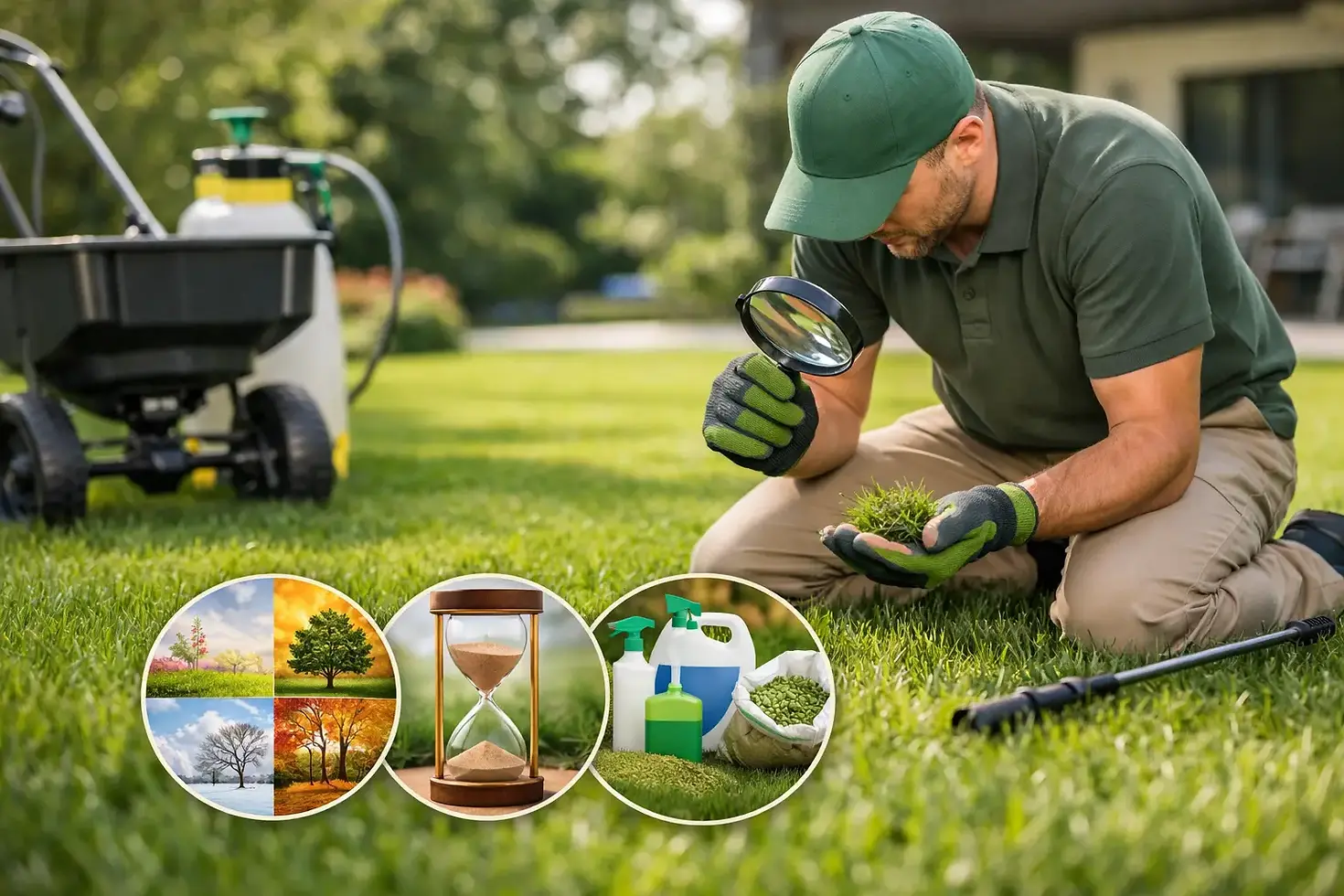
How Often Should Lawn Be Treated?
- LawnLogIQ

- May 21
- 5 min read
A lawn that looks strong in May and falls apart by August usually has not suffered from a lack of products. It has suffered from a lack of oversight. That is the real answer behind the question, how often should lawn be treated. Most lawns do not fail because they missed one application. They fail because they were put on a rigid schedule that ignored soil chemistry, weather patterns, turf type, weed pressure, and timing.
For homeowners who expect a consistently high-performing lawn, the right frequency is rarely a simple five-visit or six-visit calendar. Treatment frequency should match the biological pace of the lawn. Management over maintenance is the difference.
How often should lawn be treated for real results?
The short answer is that most established lawns benefit from active attention far more often than they receive full chemical applications. In practical terms, many lawns need inspection and decision-making every two to three weeks during the growing season, while actual treatment events vary based on need.
That distinction matters. A lawn may not need fertilizer every two weeks, but it may absolutely need to be evaluated that often. Weed breakthroughs, fungal pressure, grub activity, heat stress, and nutrient imbalance do not wait for a generic holiday-weekend schedule.
Traditional lawn care companies often build around operational efficiency. They standardize routes, standardize products, and standardize timing. That works well for scale. It does not always work well for turf. A premium lawn program should be built around agronomic conditions, not convenience.
Why generic treatment schedules underperform
The common 5-to-7-step model became popular because it is easy to sell and easy to understand. Pre-emergent in spring, some fertilizer, a weed control visit or two, maybe grub control, then fall feeding. It sounds complete. On paper, it covers the season.
The problem is that a lawn is not a paper schedule.
One property may have compacted soil, elevated pH, and low potassium. Another may have shade stress, chronic crabgrass pressure near hardscape edges, and irrigation inconsistency. A third may look healthy from the street but be carrying thin root mass and poor microbial activity below the surface. Applying the same sequence to all three is not precision. It is distribution.
This is why homeowners in places like Bartlett and the surrounding West and Northwest Chicago suburbs often feel disappointed after using conventional providers for several seasons. They are buying treatments, but not necessarily getting management. The lawn receives product, but not enough interpretation.
Frequency depends on four variables
If you want an honest answer to how often should lawn be treated, start with the variables that actually control the answer.
Soil condition
Soil is the operating system. If nutrient availability is off, if pH is limiting uptake, or if organic matter and biological activity are weak, treatment frequency changes. A lawn with stable, balanced soil may need fewer corrective inputs and more strategic seasonal support. A lawn with poor soil performance may require tighter monitoring and a more deliberate nutrient plan.
This is why testing matters. We do not guess; we test. Without data, frequency becomes opinion.
Seasonal timing
Cool-season turf in northern Illinois behaves differently in April than it does in July. Spring growth can be aggressive, which means nutrient response, weed competition, and mowing pressure all increase. Summer shifts the conversation toward stress tolerance, hydration balance, disease risk, and root preservation. Fall is often the best window for recovery, density improvement, and nutrient storage.
A fixed annual count does not capture those seasonal changes. A smart program does.
Turf pressure
Weed populations, insect threats, and disease risk are not evenly distributed from property to property. A lawn bordering unmanaged areas or backing up to common space may see more encroachment. A lawn with a history of white grubs or recurring broadleaf weeds often needs tighter intervention timing than a cleaner site.
The question is not just how many times you treat. It is how quickly you identify a problem before it becomes expensive.
Performance expectations
Not every homeowner wants the same result. Some are satisfied with a lawn that is generally green and mostly controlled. Others want density, color consistency, clean edges, low weed visibility, and strong summer resilience. Higher standards require higher oversight.
That is true in every managed system. Elite outcomes come from tighter tolerances.
What a better lawn treatment rhythm looks like
For a high-performing residential lawn, a disciplined management rhythm usually includes regular inspections throughout the growing season and a targeted sequence of nutrient, weed, and preventive treatments based on actual conditions.
That often means roughly 12 to 15 touchpoints per year in a true management model, though not every visit is a blanket application. Some visits are evaluative. Some are light corrections. Some are timed around pre-emergent barriers, broadleaf activity, grub prevention, or seasonal fertility needs.
This is a very different philosophy from a commodity spray program. Instead of asking, "What do we always put down in June?" the better question is, "What does this lawn require right now, and what should be prevented before the next inspection cycle?"
That shift is where consistency comes from.
More treatments do not always mean better treatment
There is a trade-off here, and it is worth stating clearly. High frequency without technical discipline can be just as wasteful as low frequency without oversight. More visits only have value when each visit is informed by data, observations, and a defined agronomic objective.
Overapplication can create its own problems. Too much nitrogen can push top growth at the expense of root balance, increase mowing burden, and intensify summer stress. Poorly timed herbicide use can reduce effectiveness or create unnecessary strain on already stressed turf. Preventive products applied outside the correct window can miss their target entirely.
So the answer is not simply "more." It is "more precise, more responsive, and more accountable."
When standard schedules may be enough
There are cases where a traditional program can be adequate. If a lawn already has decent soil structure, low weed pressure, moderate expectations, and no meaningful history of pest or disease issues, a simpler schedule may produce acceptable results for a period of time.
But acceptable is not the same as optimized.
Homeowners who become frustrated with inconsistency usually reach that point because standard programs are designed to be broadly sufficient, not property-specific. They can maintain an average lawn. They often struggle to elevate a lawn or correct one that has underlying limitations.
Signs your lawn needs more frequent management
If your lawn greens up early but thins out by midsummer, if weeds seem to reappear between visits, if color and density vary across the property, or if every season feels like starting over, frequency is probably not the only issue. The bigger issue is whether anyone is watching closely enough to adjust in real time.
Other warning signs include recurring crabgrass breakthroughs, persistent clover or broadleaf patches, unexplained yellowing, bare areas that never fully recover, and visible performance differences despite regular treatments. These are usually signs of an unmanaged variable, not simply bad luck.
A lawn should not be treated like a static surface. It is a living system with changing demands.
The right question to ask a lawn provider
Instead of only asking how often should lawn be treated, ask how often your lawn is evaluated, what data informs the treatment plan, and how the provider decides when to change course.
That conversation reveals a lot. If the answer is a pre-set annual package with little mention of soil testing, monitoring, or property-specific adjustments, you are likely buying routine service. If the answer includes lab-certified analysis, documented prescriptions, site observations, and high-frequency inspection intervals, you are dealing with actual turf management.
That distinction is especially important for homeowners who care about standards. A premium property deserves more than commodity timing.
The best lawns are not built by hitting a number of visits. They are built by paying attention at the right intervals, applying the right materials for the right reasons, and correcting small issues before they become visible setbacks. If you want a lawn that performs the way the rest of your property does, treat frequency as a management question, not a package feature.


Comments