
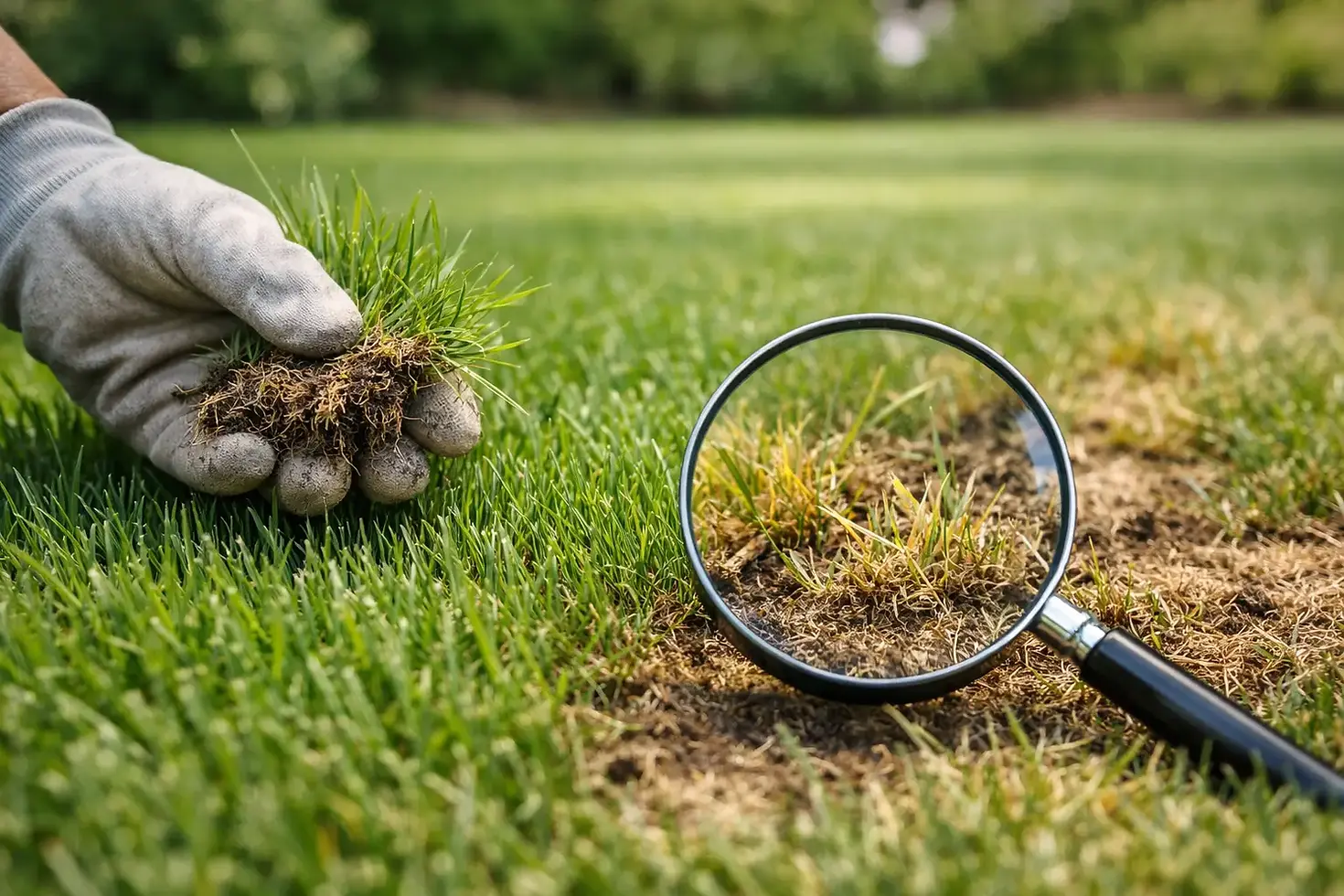
Lawn Nutrient Deficiency Symptoms to Watch

A lawn can look "off" for weeks before it fully declines. The color softens, growth slows, and certain areas stop responding the way they should. Those early lawn nutrient deficiency symptoms are often misread as drought stress, disease, or poor mowing, which is exactly how small imbalances turn into visible performance problems.
For homeowners who expect a lawn to hold density, color, and resilience through a Midwest growing season, the key is not spotting yellow grass and throwing fertilizer at it. The key is diagnosis. Turf response is driven by soil chemistry, root activity, moisture conditions, clipping management, and the relationship between major and minor nutrients. We do not guess. We test.
What lawn nutrient deficiency symptoms actually look like
Nutrient deficiencies rarely announce themselves with a neat label. Turfgrass tends to express stress through a handful of visible changes: pale color, uneven growth, thinning, weak recovery, and patchy performance across the property. The challenge is that different deficiencies can look similar at first, especially to homeowners who have been trained by commodity lawn programs to expect a one-size-fits-all answer.
Nitrogen deficiency is the one most people recognize. The lawn loses its rich green color and shifts toward light green or yellow-green. Growth slows noticeably, clipping volume drops, and the turf may look thin or tired even when irrigation is adequate. In established lawns, the change is often broad and uniform rather than sharply localized.
Potassium deficiency is less obvious in the early stages. Color may remain fairly acceptable, but the lawn becomes less resilient. You may notice poor heat tolerance, more edge burn, increased traffic stress, or slower recovery after summer pressure. In practical terms, the lawn stops behaving like a strong stand of turf and starts acting fragile.
Phosphorus deficiency is harder to identify visually without context. Turf may appear stunted, thin, or unusually dark green in some cases, sometimes with a purplish cast depending on species and conditions. More importantly, phosphorus issues tend to show up in root development and establishment performance, which means the damage is often happening below the surface before homeowners see a clear top-growth symptom.
Iron deficiency causes chlorosis, especially in newer growth. The lawn can turn yellow while the veins remain relatively greener, although this is not always easy to distinguish without experience. Iron-related color loss is frequently confused with nitrogen deficiency, but the correction path is different. If you treat an iron problem as a nitrogen problem, you can push growth without solving the underlying issue.
Micronutrient deficiencies, including manganese or magnesium in certain soil conditions, can also create off-color turf, weak vigor, and inconsistent visual quality. These are not the first place to look in every lawn, but on high-pH soils or sites with a history of repeated blanket applications, secondary and micronutrient imbalances become more plausible.
Why symptoms alone are not enough
Visible symptoms matter, but they are not the same as a diagnosis. Yellow grass does not automatically mean nitrogen deficiency. It can also point to iron unavailability, compacted soils, shallow rooting, excess moisture, high pH, root-feeding insects, or disease pressure. The same is true for thinning. A lawn can thin because it lacks nutrients, but it can also thin because the soil environment prevents the plant from using what is already present.
This is where lower-cost lawn programs usually break down. They are built on schedule-based applications, not agronomic oversight. If the lawn looks pale in June, it gets fed. If it looks weak in August, it gets another round. That approach may improve color temporarily, but temporary color is not the same as turf health.
High-performance lawns require context. A deficiency can be true deficiency, where the nutrient level is genuinely too low. It can also be induced deficiency, where the nutrient exists in the soil but is not available to the plant because of pH imbalance, poor microbial activity, moisture extremes, or antagonism from another nutrient. Those are very different problems, and they should not be treated the same way.
The most common nutrient patterns in Midwest lawns
In the Bartlett area and across the West and Northwest Chicago suburbs, cool-season lawns typically deal with a familiar set of pressures: spring flush, summer heat stress, variable rainfall, compacted suburban soils, and years of generic treatment history. That combination tends to create recurring nutrient patterns rather than isolated textbook deficiencies.
Nitrogen is the most commonly under-managed element because it directly influences color, density, and growth response. But simply applying more nitrogen is not always the answer. Too much at the wrong time can increase surge growth, reduce efficiency, and leave the lawn more vulnerable to stress. Precision matters.
Potassium is often underappreciated by homeowners because its deficiency is not as visually dramatic at first. Yet it plays a major role in stress tolerance, water regulation, and overall plant function. A lawn with marginal potassium may still look acceptable during mild weather and then fade quickly under summer pressure.
Iron availability is another frequent issue in higher-pH soils. The lawn may have enough iron on paper, but the plant cannot access it efficiently. That creates a frustrating situation where the turf lacks deep color despite regular feeding. More fertilizer does not fix that. Correct interpretation does.
Phosphorus is more nuanced. Some properties have adequate or elevated phosphorus levels already, especially where routine applications have gone on for years without testing. In those cases, applying more is unnecessary and sometimes counterproductive. Management over maintenance means matching inputs to actual need, not habit.
How to tell deficiency from other turf problems
Pattern matters. If discoloration is uniform across large areas, nutrient issues become more likely. If the problem follows strips, circles, edges, or isolated pockets, you may be looking at spreader error, irrigation inconsistency, localized compaction, grub activity, or disease expression instead.
Timing matters too. Nutrient symptoms usually develop progressively unless there has been a severe disruption in uptake. Disease tends to move differently. Drought stress often presents with footprinting, wilted blades, or folded leaves before full discoloration. Insect damage typically weakens the turf’s anchor in the soil or creates irregular areas of decline.
Response to growth conditions also provides clues. If the lawn improves briefly after rain but quickly slips back, root-zone limitations may be involved. If it greens after fertilization but remains thin or unstable, nutrition may be only part of the problem. Turf should not be judged by color alone. Density, recovery rate, uniformity, and root performance all matter.
Why testing beats visual guesswork
The right way to evaluate lawn nutrient deficiency symptoms is with soil testing backed by field observation. Soil data tells you what is present, what is excessive, what is missing, and what may be unavailable because of pH or imbalance. Field observation tells you how the turf is actually responding under current weather, mowing, and traffic conditions.
That combination changes everything. Instead of asking, "What fertilizer should I throw down?" the better question becomes, "What is limiting performance on this site right now?" Sometimes the answer is nitrogen. Sometimes it is iron availability. Sometimes it is a pH issue that keeps multiple nutrients tied up. Sometimes the turf is nutritionally adequate and the real problem is compaction or irrigation management.
A science-first program like LawnLogIQ is built around that distinction. Lab-certified analysis, repeated site visits, and custom nutrient planning are not premium add-ons. They are the minimum standard if the goal is consistent elite turf performance rather than occasional cosmetic improvement.
What homeowners should do when they notice symptoms
Start by resisting the urge to make multiple corrections at once. If you change fertilizer, irrigation, mowing height, and weed control all in the same window, you make the lawn harder to read. Turf management works best when inputs are intentional and measurable.
Look at the pattern of decline, the age of the symptom, and whether recent weather could explain part of the change. If the lawn has been cut too short, heavily watered, or subjected to heat stress, those factors need to be considered alongside nutrition. Then test the soil. A real nutrient plan starts there.
Once the data is in, the correction should be specific. That may mean adjusting nitrogen rates and timing, supplementing potassium, addressing pH to improve nutrient availability, or correcting a micronutrient issue without overstimulating top growth. The goal is not to force a quick green-up. The goal is to restore balanced performance.
Healthy turf is rarely the result of one application. It is the result of ongoing agronomic oversight, especially on established suburban lawns that have accumulated years of mixed inputs and inconsistent care. When a lawn shows you a symptom, treat it as evidence, not a verdict. The best-looking lawns are not guessed into shape. They are managed with precision.


Comments