
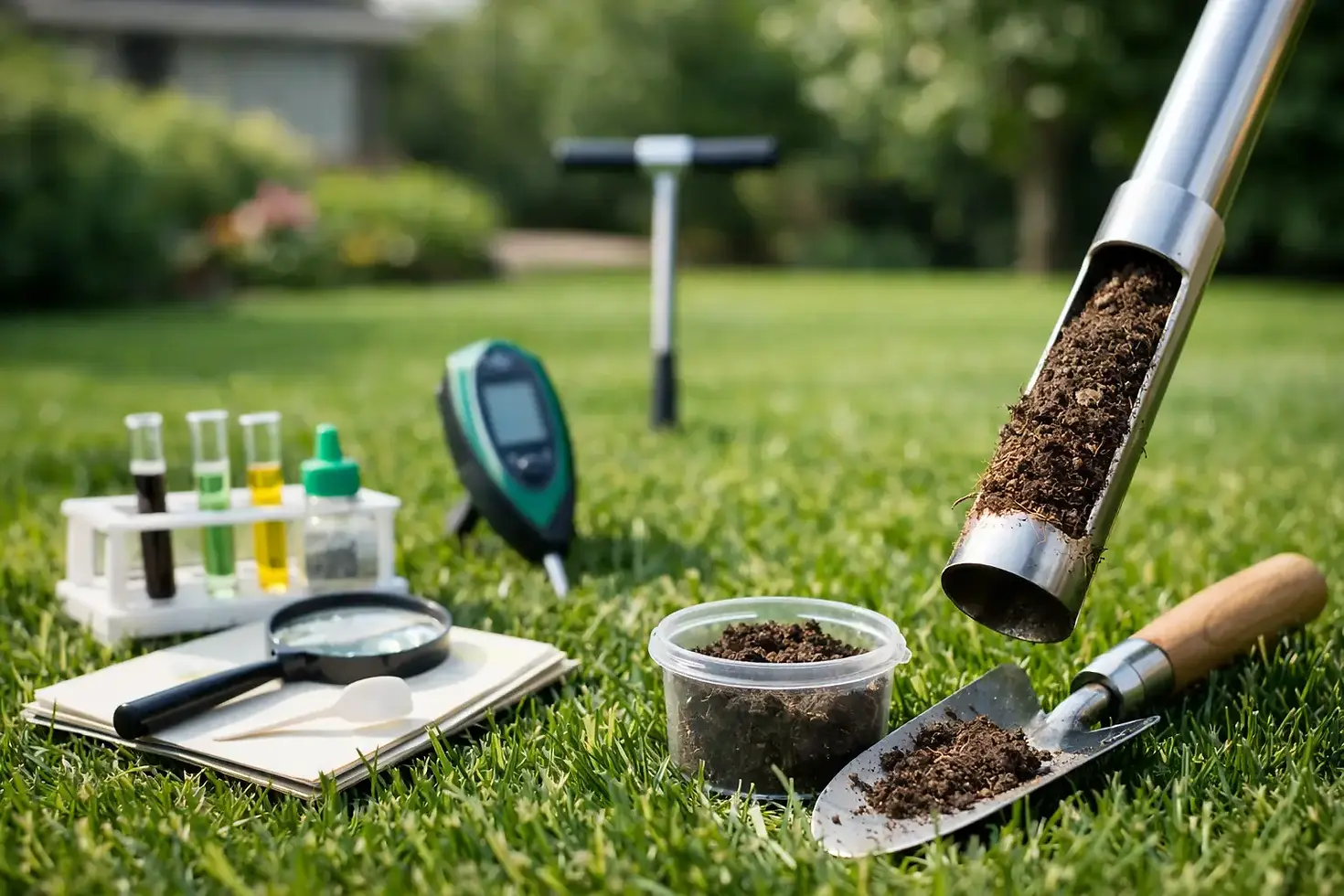
When to Test Lawn Soil for Best Results

A lawn that looks tired in May usually did not become a problem in May. The visible decline often starts months earlier in the root zone, where pH drift, nutrient imbalance, low organic matter, or poor calcium-to-magnesium ratios quietly limit performance. That is why knowing when to test lawn soil matters. Timing affects how useful the data will be, how quickly you can respond, and whether your treatment plan is based on actual conditions or educated guesswork.
For homeowners who care about consistent color, density, and stress tolerance, soil testing should not be treated like a one-time checkbox. It is a diagnostic tool. Used properly, it guides fertility, informs amendment strategy, and helps explain why one lawn plateaus while another keeps improving under the same weather conditions.
When to test lawn soil
The best time to test lawn soil is when the results can still influence a meaningful management decision. In most cool-season turf systems common across northern Illinois, that usually means late summer into fall, or early spring before major fertilizer inputs go down.
Fall is often the strongest testing window. Soil conditions are generally more stable, the lawn is entering a period of active root development, and any pH or nutrient corrections can be built into the next phase of agronomic planning. If you are serious about improving a mature lawn, fall testing gives you time to adjust before the next growing season rather than reacting after problems show up.
Early spring can also work well, especially if you want to establish a fertilizer plan before the season starts. The trade-off is that spring soils are often wetter, and the lawn may still be transitioning out of winter stress. Results are still useful, but interpretation needs to account for seasonal variability and recent environmental conditions.
If you have to choose one season, choose the one that lets you act with intention. Testing is most valuable before a fertility program is locked in, not after several blanket applications have already gone down.
Why timing changes the value of the test
A soil report is only as useful as the decisions it informs. That is where many homeowners and commodity lawn providers miss the mark. They may test at random, or not test at all, then rely on a standard 5-step or 7-step program that treats every property like it has the same chemistry. It does not.
Testing immediately after fertilizer applications can muddy the picture. Recent nutrient inputs may temporarily elevate readings and make the soil look better supplied than it truly is over the long term. If you want a more representative baseline, test before major fertilizer treatments or after enough time has passed for the soil system to stabilize.
The same principle applies after lime applications or aggressive soil amendment work. If you are trying to understand your native starting point, test before corrections. If you are trying to measure whether those corrections worked, test later with a clear purpose in mind. Different testing windows answer different questions.
That is the distinction between maintenance and management. Maintenance follows a calendar. Management uses data at the right moment.
Best seasons for cool-season lawns in Illinois
In Bartlett and the surrounding West and Northwest Chicago suburbs, most residential lawns are dominated by cool-season grasses such as Kentucky bluegrass, perennial ryegrass, and fescue blends. These lawns respond best when testing is aligned with their growth pattern.
Late summer and fall
This is often the ideal window. Turf is recovering from summer stress, root activity begins to strengthen, and you can build a precise fertility and amendment plan for the most productive part of the cool-season calendar. If the report shows low potassium, weak phosphorus reserves, poor pH, or low organic matter, you still have time to respond intelligently.
Fall testing is especially useful for mature lawns with chronic performance issues. If a property struggles with density, color retention, or disease pressure every year, a late-season lab analysis often reveals that the problem is not simply mowing height or missed fertilizer. It is usually a deeper imbalance that has been left unaddressed.
Early spring
Spring testing is practical when no recent amendments have been made and you want to establish a disciplined plan before growth accelerates. This is a common choice for new clients entering a managed program because it creates a defensible baseline before the season unfolds.
The caution is that spring can be noisy. Saturated soils, snowmelt effects, and winter injury can complicate interpretation. The data still matters, but it should be read by someone who understands turf agronomy rather than as a generic consumer printout.
Summer and winter
These are generally less ideal for routine baseline testing, though not always wrong. Mid-summer samples can still be useful if a lawn is underperforming and you need answers. Winter is less practical because frozen ground and dormant conditions limit access and responsiveness.
When a lawn is failing, do not wait for the perfect month if immediate diagnosis is needed. But for planned testing, fall and early spring remain the strongest windows.
Situations when you should test lawn soil right away
Season matters, but so does context. There are times when the correct answer to when to test lawn soil is simple: now.
If a lawn has persistent yellowing despite fertilization, repeated weed encroachment, weak recovery from heat, patchy growth, or poor density in areas that get adequate sunlight and irrigation, the soil should be evaluated. The same applies when you move into a property with an established lawn and no clear management history. Starting without a soil baseline means making expensive assumptions.
Testing is also wise before renovation or overseeding. If you are investing in seed, topdressing, irrigation adjustments, or turf repair, you want to know whether the soil environment can actually support the result you expect. Seeding into a chemically unbalanced root zone often produces disappointing establishment, and homeowners then blame the seed or the weather.
A good soil test can also clarify whether the issue is truly nutritional. Some lawns are not fertilizer-deficient. They are compacted, overwatered, cut too low, or dealing with shade and drainage limitations. Testing does not replace field observation, but it prevents nutrient management from becoming guesswork.
How often should lawn soil be tested?
For a stable lawn under disciplined agronomic oversight, every one to two years is often sufficient for full lab analysis, with frequency adjusted based on the lawn’s age, condition, and amendment history. A newly acquired property, a lawn in active correction, or a site with repeated problems may justify annual testing until the chemistry is brought into a better operating range.
A high-performance lawn should not be managed with the same rhythm as a neglected lawn getting generic treatments. If a property owner expects elite results, the diagnostic cadence has to match that standard. We do not guess; we test, then we retest with a purpose.
That does not mean every visit requires a full lab panel. It means major decisions about pH correction, macro and micronutrient strategy, and long-term soil improvement should be anchored to real data rather than seasonal habit.
What a useful soil test should actually measure
Not all tests are equally useful. A low-cost basic reading may give you pH and a limited nutrient snapshot, but that often is not enough to support premium turf management. For established residential lawns, a more meaningful analysis should evaluate pH, buffer pH where applicable, phosphorus, potassium, calcium, magnesium, sulfur, organic matter, and key micronutrients. Interpretation matters just as much as the numbers.
The goal is not to chase perfect textbook values in isolation. It is to understand how the soil profile is supporting the turf you actually have, under the climate and stress patterns your property experiences. A lawn can have acceptable nitrogen inputs and still underperform because pH is restricting nutrient availability. Another may show adequate potassium on paper yet still suffer from poor vigor due to imbalances elsewhere in the exchange complex.
That is why serious programs start with lab-certified analysis and then translate the report into an actual prescription. Data without agronomic reasoning is just paperwork.
The bigger mistake is testing too late
Most homeowners do not ignore their lawn. They respond to it. The problem is that they often respond after decline becomes visible, which is usually late in the sequence. By then, the correction window may be narrower, and the lawn has already given up ground in color, density, or root strength.
Testing late is still better than not testing at all. But the real advantage comes from testing early enough to shape the season, not just explain it. That is how a managed lawn separates from a treated lawn.
If your goal is a lawn that holds its appearance through stress, responds predictably to fertilization, and improves year over year, timing the soil test is not a minor detail. It is one of the first disciplined decisions that makes the rest of the program smarter.
A good lawn rarely happens because someone applied more product. It usually happens because someone finally measured the soil, read the signals correctly, and acted before the lawn had to ask twice.


Comments