
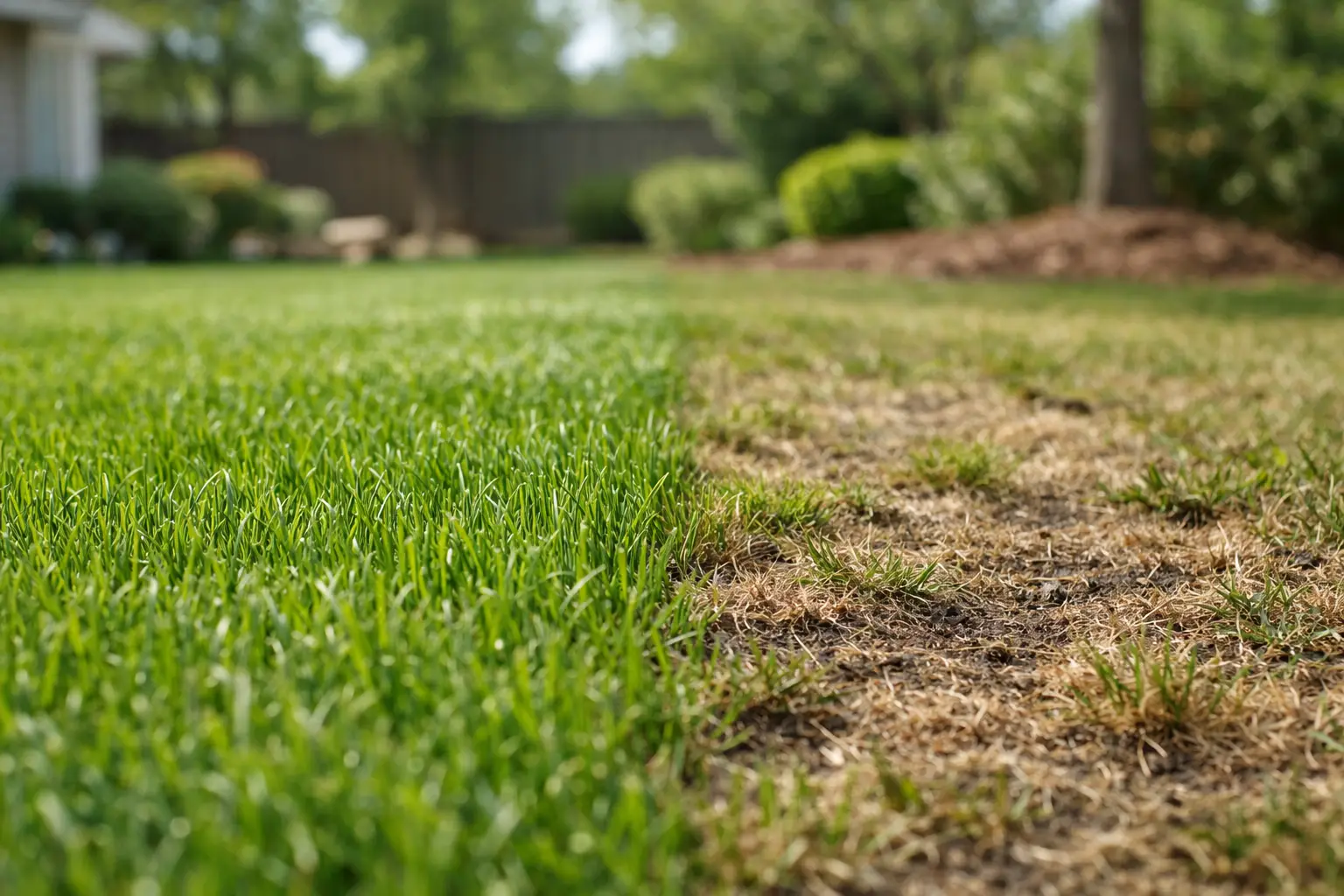
Why Does My Lawn Thin Out Over Time?

A lawn rarely thins out for no reason. If you're asking, why does my lawn thin out, the better question is usually: what changed in the plant, the soil, or the environment that reduced turf density? Grass does not lose coverage all at once unless there is a severe event. More often, it declines gradually, then becomes obvious when the canopy opens up, weeds move in, or color becomes uneven.
That distinction matters. Thin turf is not a cosmetic issue first. It is a performance issue. Density is one of the clearest indicators of lawn health because it reflects how well the grass is growing, recovering, and competing. When density slips, something in the system is underperforming.
Why does my lawn thin out in the first place?
Most thinning comes back to one of five categories: poor soil function, light limitations, biological feeding, environmental stress, or management imbalance. In many lawns, more than one factor is active at the same time. That is exactly why generic treatment schedules often underdeliver. They assume the cause before diagnosing it.
A lawn can look acceptable in April, struggle in June, and look sparse by August for reasons that are completely different from the homeowner's first guess. What appears to be "not enough fertilizer" might actually be compacted soil reducing root oxygen. What looks like drought stress may be shallow rooting caused by frequent light irrigation. What seems like normal summer decline may be grub feeding combined with heat pressure.
We don't guess; we test. That mindset is what separates agronomic management from commodity lawn treatment.
Soil problems are one of the most common reasons a lawn thins out
Grass density is built from the ground up. If the root zone is chemically out of balance or physically restricted, turf loses vigor long before it fully dies. You may still see green blades, but the plant is no longer producing lateral growth or recovering from stress efficiently.
Nutrient imbalance is not the same as low fertility
Many homeowners assume thinning means the lawn needs more fertilizer. Sometimes it does, but excess or poorly timed fertility can create its own problems. Grass needs the right nutrients in the right ratios, available at the right time. A lawn can be thin even when nutrients are present if pH is limiting uptake, potassium is inadequate for stress tolerance, or phosphorus levels are locked up.
This is where lab-certified soil analysis matters. It tells you whether the issue is shortage, excess, or availability. Those are very different problems, and each requires a different correction.
Compaction and low oxygen reduce root performance
In established suburban lawns, especially on heavier Midwest soils, compaction is a frequent contributor to thinning. Traffic, construction history, and natural settling compress the root zone and reduce pore space. When that happens, roots struggle to access oxygen and water movement slows.
The result is subtle at first. The lawn greens up unevenly, recovers slowly, and enters summer with less resilience. Then heat arrives, roots underperform, and the stand starts opening up.
Organic matter and biological function also matter
Healthy turf is not just a fertilizer response. Soil biology influences nutrient cycling, root interaction, and thatch decomposition. If the soil is biologically weak or chronically stressed, the lawn often becomes less stable over time. It may still respond to inputs, but not with the density or consistency a premium property owner expects.
Shade is a major thinning factor, and it gets worse over time
If your lawn is thinning near tree lines, on the north side of the house, or in areas with increasing canopy cover, light is likely part of the problem. Grass is an energy-driven plant. Less sunlight means less photosynthesis, which means less energy for root growth, recovery, and density.
More shade means fewer tillers and weaker recovery
Turf in shaded areas typically grows with longer, weaker blades and produces less lateral thickening. It also stays wetter longer, which can increase disease pressure. Even a lawn that handled moderate shade a few years ago may thin as trees mature and block more light.
This is one of the clearest examples of why cause matters. If the area is receiving insufficient usable sunlight, adding more fertilizer will not solve the problem. In some cases, it makes the turf more fragile. The fix has to match the limitation.
Insects can thin turf surprisingly fast
Not every insect causes visible lawn damage, but some absolutely do. In our region, grubs are one of the most important examples because they feed on roots. When root mass is reduced, the plant loses its ability to hold moisture and support the leaf canopy.
Grub damage often shows up after the feeding has started
Homeowners usually notice grub-related thinning when turf begins to feel soft underfoot, pulls back easily, or declines in irregular patches during warm weather. At that point, the damage is already underway. The grass is not thin because it suddenly "stopped growing." It is thin because the root system has been compromised.
Preventive management is usually more effective than reacting after visible collapse. That is especially true in lawns with a prior history of grub pressure.
Water stress is often about rooting depth, not just rainfall
A thin lawn in summer is commonly blamed on heat, but heat alone is rarely the full story. Turf survives summer stress best when it has deep, functional roots and balanced nutrition. If irrigation habits have trained the lawn to root shallowly, or if the soil profile limits infiltration, the grass becomes vulnerable much faster.
Too little water and too much water can both reduce density
Underwatering leads to dormancy and loss of vigor. Overwatering can be just as damaging because it reduces oxygen in the soil, weakens roots, and can increase disease pressure. The goal is not constant surface moisture. The goal is supporting deeper rooting and consistent plant function.
This is one reason timing and monitoring matter. The same amount of water can perform very differently depending on temperature, soil type, and root depth.
Disease pressure can make a lawn look thin before it looks dead
Certain turf diseases do not create dramatic overnight failure. They create a slow reduction in stand quality. You may see off-color areas, melting leaf tissue, patchy recovery, or recurring weak zones that never fully fill back in.
In dense, high-value lawns, disease often exploits an existing weakness. Excess moisture, poor airflow, shade, unbalanced fertility, and stressed roots all increase the risk. The mistake is treating the symptom without correcting the condition that made the turf vulnerable in the first place.
Why thin lawns often get worse year after year
Once turf density declines, competition shifts. Open canopy means more sunlight reaches the soil surface, which encourages weed germination and further destabilizes the stand. The lawn then has fewer healthy plants available to recover from stress, and the cycle compounds.
This is why waiting usually makes correction more expensive and slower. A lawn that is only mildly thin in spring may require targeted agronomic adjustments. The same lawn, ignored through summer and fall, may require more intensive rebuilding.
How to figure out why your lawn is thinning
The fastest path to a real answer is a disciplined diagnostic process. Start with pattern recognition. Is the thinning uniform or patchy? Is it tied to sun exposure, slope, irrigation coverage, or traffic? Did it worsen during heat, after heavy rain, or in the same places as last year?
Then move below the surface. Inspect the root zone. Check for compaction, thatch excess, moisture inconsistency, and insect activity. Evaluate whether the lawn is actually being limited by soil chemistry instead of surface appearance. A proper soil test is not a luxury on a premium property. It is the baseline for intelligent decisions.
Why does my lawn thin out even with regular treatments?
Because regular treatments are not the same as actual management. A standard 5-to-7-step program may suppress weeds and add seasonal fertilizer, but it does not automatically identify root loss, pH imbalance, compaction, shade progression, or biological decline. Frequency matters. So does customization.
A lawn changes throughout the season. Conditions shift, stress accumulates, and weak areas emerge before they fully fail. High-frequency inspection catches those signals earlier, when they are still manageable.
The fix depends on the cause
There is no honest universal answer because thinning is a symptom, not a diagnosis. Some lawns need nutrient correction. Some need preventive grub management. Some need a different irrigation pattern, better monitoring, or a more realistic plan for shaded areas. In a lot of established lawns, the right answer is a coordinated combination rather than a single product application.
That is the larger point. Density is earned through oversight. When a lawn stays full, resilient, and consistent through spring flush, summer stress, and fall recovery, that is usually the result of management over maintenance.
If your lawn is thinning, treat that as useful data. The grass is showing you where the system is falling short. The sooner you identify the real limiting factor, the sooner the lawn can start behaving like a healthy stand again instead of a recurring project.


Comments